
Work the candidate described.
The demo summary describes staged warehouse rollouts and a reduction in after-hours deployment pages from 19 to 7 per month. These are claims in a demonstration record, not measured Evidize customer results.
Candidate Intelligence Hub
Keep the résumé, linked roles, interview notes, scorecards, and open questions together so the next reviewer can pick up where the last conversation ended.
Explore a prepared example. Sharing your own workflow is optional.
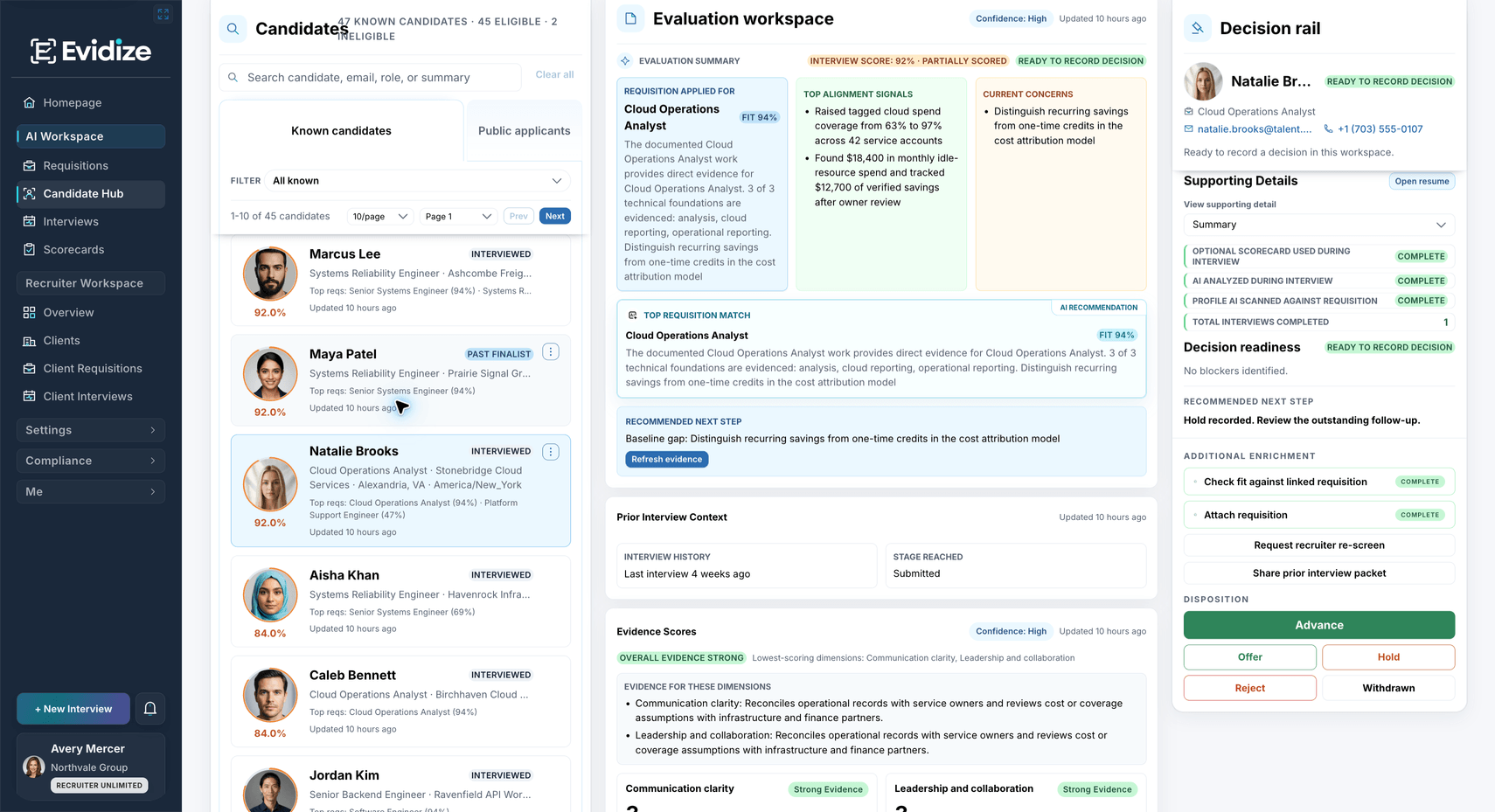
Marcus Lee · Senior Systems Engineer. The demo record describes staged warehouse rollouts, while asking which checks were automated and which still required an operator.
Scroll the image horizontally when needed to read the detail.
View full product screenshot: One candidate. The next question in view. →A handoff with a purpose
Marcus Lee’s Senior Systems Engineer demo record already contains warehouse rollout evidence. The next interviewer can start with the specific question the previous review left open.
The demo summary describes staged warehouse rollouts and a reduction in after-hours deployment pages from 19 to 7 per month. These are claims in a demonstration record, not measured Evidize customer results.
The visible concern asks which warehouse rollout checks were automated and which still required an operator. The summary does not resolve that distinction.
“Which checks ran automatically, which needed an operator, and how did you test whether each check caught a failed deployment?”
The suggested interview question is an illustrative follow-up to the visible demo record, not an answer the candidate has already given. Missing information remains unassessed.
Connected candidate knowledge
Use the available record to understand the previous conversation before choosing what to do next.
Review the source information and available summaries. Check important claims against the original record.
Keep linked roles and requirements in view so evidence is assessed against the work your team needs done.
Revisit the questions, ratings, and reviewer notes that informed earlier conversations.
Understand the previous decision and what still needs confirming before another review.
When another role opens
A past interview can be a useful starting point for a new search. Review what is still relevant before reconnecting the candidate with a role.
A match does not establish availability or automatically contact or advance anyone. Reuse remains subject to your organization’s access, retention, and lawful-use responsibilities.
Understand the adoption work
Choose an intake path that fits your workflow, then keep source information and reviewer context current.
| Starting point | Available workflow | Your team’s role |
|---|---|---|
| Existing candidate or interview record | Review available profiles, linked interviews, and scorecards with Candidate Hub access. | Check the record, linked role, open questions, and previous outcome. |
| An individual résumé | Individual résumé intake and analysis on plans with the résumé workspace. | Supply the appropriate record and review summaries against the source. |
| Many résumés | Bulk résumé upload on Enterprise and Recruiter Unlimited. | Prepare the intake, monitor processing, and review exceptions and generated results. |
| Public applications | Public applicant and ATS workflows on plans with ATS access. | Configure the role and application process and manage applicant progression. |
An active plan, available usage, and appropriate permissions are required for the relevant workflows. Confirm your intake and migration needs before rollout.
Compare plan capabilities →Candidate context stays accountable
Yes. Reviewers can compare two records side by side and record the team’s rationale for a next step. Incomplete scores and missing information need review; they are not evidence that a candidate lacks ability. See the shortlist workflow.
No. Summaries and scores help navigate available information. Review them against source records and use fair follow-up to clarify uncertainty. Evidize does not predict performance or make hiring decisions.
Access depends on the organization, user permissions, and plan. Your organization remains responsible for the appropriate use and retention of candidate information, including when considering someone for a later role.
Follow one candidate from the available record to an open question, a reviewer handoff, and a considered next step. We can use a prepared example and discuss your intake requirements without needing candidate data from you.
See one candidate through the handoff
Explore the record, the unresolved question, and the reviewer’s next step. Then review how your team would bring its candidate information into Evidize.