
Define the role
Agree on the work, responsibilities, and evidence your team needs before comparing candidates.
From role requirements to human review
Compare candidates against the same role requirements, review supporting notes, and identify what still needs confirming.
Explore a prepared example. Sharing your own workflow is optional.
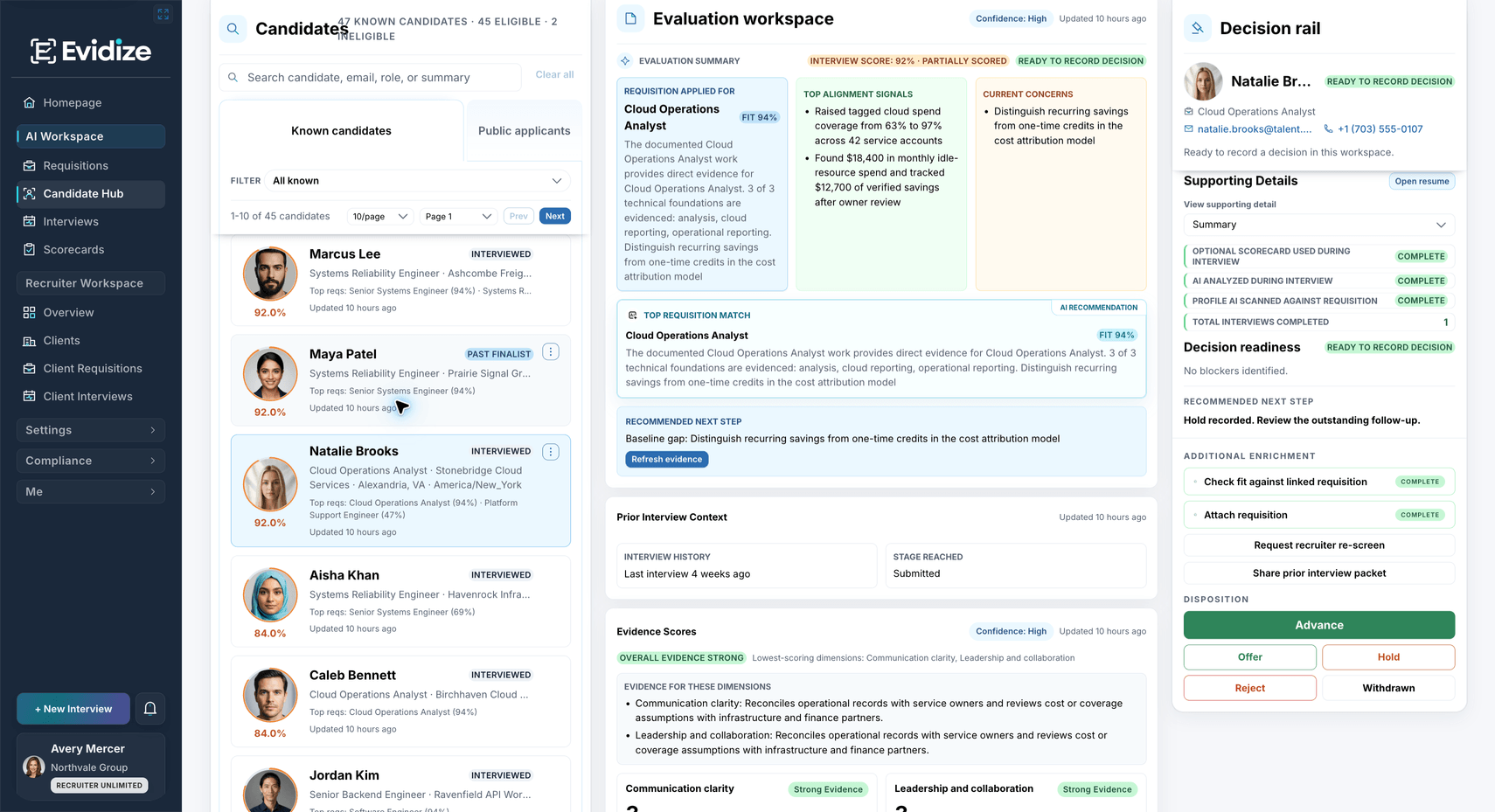
Marcus Lee · Senior Systems Engineer. The demo record shows relevant warehouse automation work and keeps the remaining question visible beside it.
Scroll the image horizontally when needed to read the detail.
View full product screenshot: One role. Evidence and an open question. →Follow the same demo record
Start with the Senior Systems Engineer role, read the available evidence, and carry the unresolved question into the next interview.
| Review point | Visible in this demo record |
|---|---|
| Role context | The evaluation links Marcus to Senior Systems Engineer and identifies infrastructure tooling, automation, and operational diagnostics as relevant foundations. |
| Available evidence | The summary describes staged warehouse rollouts that reduced after-hours deployment pages from 19 to 7 per month, plus a reduction in message replay time from 42 to 11 minutes. |
| Still uncertain | Which warehouse rollout checks were automated and which still required an operator. The interview is labeled partially scored; the optional scorecard shows 5 of 6 rated. |
| Recorded next step | The decision rail says “Advance recorded. Arrange the next interview.” The open question remains visible. |
Product demonstration data, not an actual hiring result or an Evidize customer performance claim. A recorded Advance does not prove that every question has been resolved or explain the reviewer’s full rationale.
Missing information is a prompt to ask, not proof of missing ability. Evidize does not predict performance or automatically advance or reject candidates.
One connected hiring standard
Each stage builds on the role and candidate context your team has already reviewed.
Agree on the work, responsibilities, and evidence your team needs before comparing candidates.
Read the résumé and available history against those requirements. Keep unconfirmed claims visible.
Turn open questions into editable interview prompts and record the answer with shared scoring guidance.
Compare the available evidence, discuss uncertainty, and record your team’s rationale.
Evidence travels with the next step
Marcus’s demo record has an Advance recorded. The hiring team still needs to examine the open warehouse-check question; the status alone does not answer it.
“Walk through one warehouse deployment. Which checks ran automatically, which needed an operator, and how did you test those checks?”
Record the answer, what supports it, and any remaining uncertainty. A question that was not asked should remain unassessed.
The demo decision rail shows a human-controlled outcome alongside incomplete optional scoring. Reviewers remain responsible for the evidence and the decision.
View full product screenshot: The same candidate’s recorded next step →Plan your evaluation
Yes. Evidize can sit alongside an ATS without requiring a built-in connection. Available intake and movement of information depend on your setup and plan; confirm that workflow during the demo.
Start with a role brief and agree on what the interview should establish. Review suggested questions and summaries for accuracy and relevance. We can use a prepared demonstration; sharing your own role is optional.
Your authorized hiring team. Review the source information, resolve uncertainty, and record the rationale for every advancement, rejection, or other outcome.
Core and Enterprise include Candidate Hub and structured scorecards. Recruiting plans also include these workflows. Bulk intake and ATS access have separate plan requirements. Compare current plan capabilities.
See the whole review
See the comparison, the questions behind it, and the setup your team would need. We can use a prepared example; your own role brief is optional.